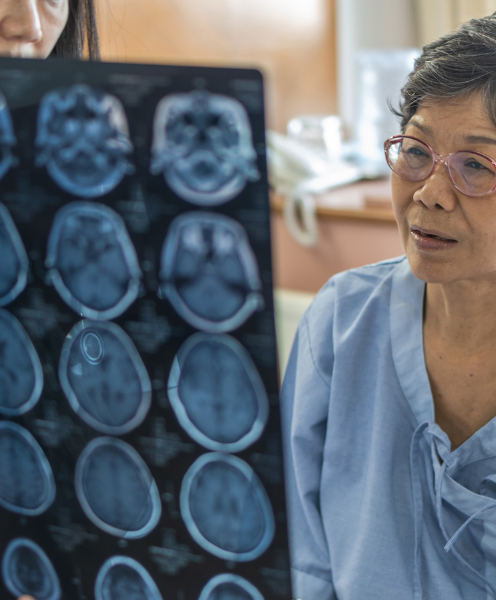
Traumatic Brain Injury (TBI) is a disruption in the normal function of the brain that can be caused by a bump, blow, or jolt to the head, or penetrating head injury. Everyone is at risk for a TBI, especially children and older adults. Symptoms of a TBI can be mild, moderate, or severe, depending on the extent of the damage to the brain.
TBI is a significant cause of death and disability worldwide, especially in children and young adults. The CDC estimates that about 2% of the U.S. population needs long-term help to perform daily living activities as a result of a TBI. 1.4 million individuals in the U.S. sustain a TBI each year.
Disabilities that stem from a TBI depend on the individual’s severity, location, age, and health condition. TBI can cause a wide range of functional changes affecting thinking and sensation. Some common disabilities include problems with cognition (thinking, memory, and reasoning), sensory processing (sight, hearing, touch, taste, and smell), communication (expression and understanding), and behavior or mental health (depression, anxiety, personality changes, aggression, acting out, and social inappropriateness).
About Disorder
Screening and Diagnosis
Danger Signs in Children:
Take your child to the emergency room right away if they received a bump, blow, or jolt to the head or body, and:
Have any of the danger signs for adults listed below.
Will not stop crying and is inconsolable.
Will not nurse or eat.
Danger Signs in Adults:
In rare cases, a dangerous blood clot that crowds the brain against the skull can develop. The people checking on you should take you to an emergency department right away if you have:
Headache that gets worse and does not go away.
Weakness, numbness, or decreased coordination.
Repeated vomiting or nausea.
Slurred speech.
Look very drowsy or cannot wake up.
Have one pupil (the black part in the middle of the eye) larger than the other.
Have convulsions or seizures.
Cannot recognize people or places.
Are getting more and more confused, restless, or agitated.
A health care professional should provide a treatment plan. When rehabilitation is required, it may include seeing different specialists, such as physiatrists, neuropsychologists, social workers, rehabilitation nurses, and vocational counselors. Also may include occupational, physical, speech, and language therapists.